Plan Smarter. Grow Stronger. Don’t miss our latest financial strategies.


July 28, 2026
Form 1041 vs 1040 – Who Actually Pays Tax on Trust Income?
✅ Information Verified By a CPA





Inheriting wealth through a trust is a significant financial event, but it brings immediate administrative confusion. Beneficiaries frequently assume that once assets are placed inside a trust, the tax obligations vanish or are handled entirely by the entity itself.
The IRS tracks every dollar of income generated by trust assets, and a clear division of labor exists between the trust's tax filings and your own. The core question isn't just how to report the income, it's who pays tax on it in any given year.
Form 1041 vs. Form 1040
The confusion around trust taxation stems from the fact that an irrevocable trust is a distinct legal and tax-paying entity.
- Form 1041 (The Fiduciary Tax Return): This is the trust's own income tax return. The trustee files it annually to report all income generated by the trust's underlying assets, interest, dividends, rental income, or business profits.
- Form 1040 (The Individual Tax Return): If you receive distributions from the trust, you report your share of that income on your personal Form 1040, specifically on Schedule E, Part III.
The tax code prevents double taxation through a mechanism known as the conduit theory. The trust acts as a pass-through: income it distributes to you is taxed on your Form 1040, while income it retains is taxed on Form 1041.
How Distributable Net Income (DNI) Flows Distributable Net Income (DNI) flows
DNI represents the maximum amount of trust income that can be taxed to the beneficiaries in a single year. The flow of tax responsibility follows a strict three-step sequence:
- The trust reports gross income. The trustee tallies all taxable income generated by the trust's investments, bank accounts, or real estate, and reports the total on Form 1041.
- The trust claims an income distribution deduction. To the extent the trustee distributes that income to beneficiaries, the trust claims a deduction on Form 1041 that reduces its own taxable income.
- The beneficiary reports the income. The trustee issues a Schedule K-1 to each beneficiary, showing exactly what portion of their distribution counts as taxable income. The beneficiary copies those figures onto their own Form 1040.
Simple vs. Complex Trusts
How this income gets handled depends on whether the trust is classified as simple or complex under the tax code.
- Simple trusts are legally required to distribute all trust accounting income to beneficiaries every year. They can't accumulate income inside the trust, and they can't distribute principal. Because all income flows out annually, a simple trust acts as a pure conduit: the trust itself pays $0 in income tax, and beneficiaries pay 100% of the tax on their personal returns.
- Complex trusts aren't required to distribute all their income. The trustee has discretion to either distribute it or accumulate it inside the trust. If distributed, the tax obligation passes to the beneficiary's Form 1040. If accumulated, the trust pays the tax on Form 1041 at trust tax rates.
The Capital Gains Trap
A common surprise for trust beneficiaries is how capital gains get taxed. Even when a trustee distributes all of a trust's "income" to you, capital gains are usually excluded from the DNI calculation under default IRS rules.
The IRS typically categorizes capital gains as trust principal rather than trust income. So, if the trust sells an appreciated stock and distributes the proceeds, the gain itself stays on Form 1041, the trust pays the tax on it, even though the cash reached the beneficiary.
This default can be changed if the trust agreement or state law explicitly allows allocating capital gains to DNI, but that requires careful coordination with a CPA to execute correctly.
Why Retaining Trust Income is Costly
If a complex trust accumulates income rather than distributing it, that income runs into the trust's sharply compressed tax brackets.
A single individual filing Form 1040 doesn't reach the top 37% federal bracket until taxable income crosses $640,600 in 2026. A trust filing Form 1041 hits that same 37% bracket at just $16,000.
2026 Federal Trust Tax Brackets (Form 1041)
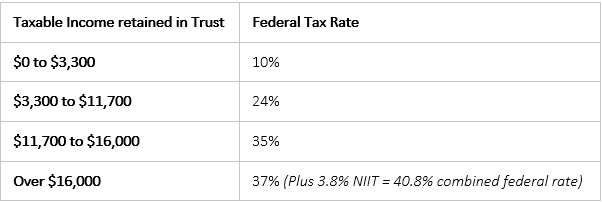
Because of this compression, keeping even $20,000 of investment income inside a trust can trigger a combined federal rate of 40.8%: the 37% top marginal rate plus the 3.8% Net Investment Income Tax. If that same $20,000 were distributed to a beneficiary in the 12% or 22% individual bracket instead, the family would save thousands of dollars in unnecessary tax.
How Sproutax Coordinates Fiduciary Tax Planning
Sproutax analyses trust taxes through both the fiduciary and individual lens, running multi-scenario models to calculate whether distributing income or retaining it inside the trust results in the lowest overall family tax bill.
The team helps trustees calculate DNI, manage capital gains allocations, and prepare Schedule K-1s carefully enough to avoid audit exposure for beneficiaries. Coordinating trust-level decisions with each beneficiary's personal return is what keeps inherited wealth from being quietly eroded by compressed brackets.
Conclusion
Whether a trust or its beneficiary ends up paying tax on inherited income comes down to distribution timing. Income passed to a beneficiary is taxed on their Form 1040; income the trust retains faces the far more compressed brackets of Form 1041.

About The Author
Alan Nathan, is a CPA and has spent more than 36 years helping individuals and trustees navigate taxation with confidence. He enjoys sharing his insights and experience to make taxes easier to understand. Throughout his career he has guided clients toward smart strategies and real savings. He believes in giving individual taxation the attention to detail it deserves and is passionate about using taxation to create opportunities for long–term financial success.
FAQs
Is the inheritance of the trust principal itself considered taxable income?

What is a Schedule K-1 (Form 1041) and when should I expect to receive it?
Can a trustee distribute cash to a beneficiary without triggering a tax bill?
How does the Net Investment Income Tax (NIIT) apply to trust income?
Get A Call From Our Team Of Expert CPAs

Get Insights
We analyze your previous year return to tell you strategies that can help you plan better.

Seamless Experience
Submit & get a call from our client relations team to connect you with our CPAs.

Pricing That Makes Sense
We tailor pricing based on the complexity of your return so that you pay the right price.

Office Address:
720 Hopmeadow Street2nd Floor
Simsbury, CT 06070
Mail: info@sproutax.com
Phone: (860) 251-9449
Phone: (860) 251-9449
© 2026 Sproutax. All rights reserved.
.svg)
.svg)
