Plan Smarter. Grow Stronger. Don’t miss our latest financial strategies.


July 14, 2026
Revocable vs. Irrevocable Trusts: How Each One Is Taxed
✅ Information Verified By a CPA





Most estate planning conversations treat a trust as a simple checklist item for avoiding probate. In practice, creating a trust changes how an estate operates, distributes money, and files with the IRS.
Choosing between a revocable living trust and an irrevocable trust comes down to a direct trade-off: lifetime flexibility versus long-term asset protection. Before signing anything, it's worth understanding exactly what shifts operationally once assets move into either structure.
Why the Trust Decision Always Comes Down to Control
The core difference between these two structures is who retains control over the assets.
In a revocable trust, the grantor keeps complete authority. They can amend the terms, swap out assets, or dissolve the trust entirely at any time. For practical purposes, the IRS and the courts treat the grantor and the trust as the same entity during the grantor's lifetime.
An irrevocable trust works the opposite way. Once assets move in, the grantor permanently gives up ownership and control: no modifying terms, no removing assets, no cancellation without beneficiary consent. In exchange, the trust becomes an independent legal entity, shielding those assets from personal liability, lawsuits, and estate taxes.
The Filing Shift: From Form 1040 to Form 1041
A revocable trust offers total control, but it doesn't change the grantor's day-to-day tax filing. The trust operates as a "grantor trust," using the grantor's own Social Security number, and all interest, dividends, and capital gains flow directly onto their standard Form 1040.
An irrevocable trust changes that workflow entirely. As an independent entity, it needs its own Employer Identification Number (EIN) from the IRS. Once it accumulates more than $600 in gross income during a tax year, it can no longer use Form 1040, and the trustee must file a fiduciary income tax return on Form 1041. That adds a separate layer of bookkeeping, its own filing deadlines, and its own accounting rules.
The Compressed Bracket Problem
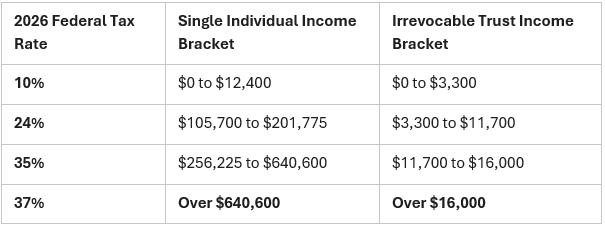
When an irrevocable trust earns income and doesn't distribute it, the tax code subjects that retained income to sharply compressed brackets.
For the 2026 tax year, a single individual doesn't hit the top 37% federal bracket until taxable income clears $640,600. An irrevocable trust hits that same 37% rate at just $16,000 of undistributed income.
The Income Distribution Strategy
To avoid losing over a third of trust earnings to federal tax at the trust level, trustees commonly use the Distributable Net Income (DNI) mechanism. By distributing earnings directly to beneficiaries, the trust claims an income distribution deduction, and the tax burden shifts to the beneficiaries via Schedule K-1, taxed at their individual, typically lower, rates.
What Happens to the Step-Up in Basis at Death
The trust structure also determines how capital gains are treated when heirs eventually inherit.
Assets in are vocable trust stay part of the grantor's gross estate for estate tax purposes. Because they never left the estate, heirs receive a step-up in basis to fair market value at the grantor's death. A stock bought for $10,000 that grows to $100,000 passes to heirs with a new cost basis of $100,000, erasing $90,000 of taxable gain.
Irrevocable trusts generally forfeit that benefit. Since the grantor removed the assets from their estate during their lifetime to secure asset protection, there's no step-up at death. Heirs inherit the original, historical cost basis and face capital gains tax on all the appreciation that occurred while the grantor was alive.
How Sproutax Approaches Trust Planning
Sproutax reviews existing trust agreements to flag where they create tax exposure, whether that's the compressed bracket trap or an unintentional loss of step-up in basis. The team doesn't draft or set up trusts; that's the role of an estate attorney. Instead, Sproutax steps in once a trust exists and handles what it means for taxes going forward.
That includes the ongoing administration of Form 1041 filings, the distribution calculations behind Schedule K-1s, and modeling how income, distributions, and capital gains will actually play out year to year. The goal is straight forward: make sure the trust's tax mechanics work in the client's favor, not against them.
Conclusion
Choosing a trust isn't a choice between two legal documents. It's a permanent decision about how a family interacts with the IRS. A revocable trust offers lifetime flexibility but no income tax break and no protection from outside liability. An irrevocable trust offers real asset shielding and estate tax reduction, but it requires permanently surrendering control and exposes retained income to the top tax bracket almost immediately.
Before executing a trust agreement, map out the actual flow of future distributions, capital gains, and filing requirements.
Book a strategy call with Sproutax to map your trust tax options

About The Author
Alan Nathan, is a CPA and has spent more than 36 years helping individuals and trustees navigate taxation with confidence. He enjoys sharing his insights and experience to make taxes easier to understand. Throughout his career he has guided clients toward smart strategies and real savings. He believes in giving individual taxation the attention to detail it deserves and is passionate about using taxation to create opportunities for long–term financial success.
FAQs
Does a revocable living trust protect your assets from a lawsuit?

Can a revocable trust become an irrevocable trust?
Who pays the federal income tax on an irrevocable trust?
Can I be the trustee of my own irrevocable trust?



Get A Call From Our Team Of Expert CPAs

Get Insights
We analyze your previous year return to tell you strategies that can help you plan better.

Seamless Experience
Submit & get a call from our client relations team to connect you with our CPAs.

Pricing That Makes Sense
We tailor pricing based on the complexity of your return so that you pay the right price.

Office Address:
720 Hopmeadow Street2nd Floor
Simsbury, CT 06070
Mail: info@sproutax.com
Phone: (860) 251-9449
Phone: (860) 251-9449
© 2026 Sproutax. All rights reserved.
.svg)
.svg)
