Plan Smarter. Grow Stronger. Don’t miss our latest financial strategies.


August 4, 2026
Avoiding the Underpayment Penalty After a Sudden Income Spike
✅ Information Verified By a CPA




A sudden windfall, selling a business, exercising options, a big bonus, feels like a win. For a lot of taxpayers, it also quietly sets up a penalty letter from the IRS: an underpayment of estimated tax penalty they never saw coming.
The U.S. tax system runs on a pay-as-you-go model. The IRS expects tax on income to be paid as it's earned throughout the year, not as one lump sum in April. When income surges mid-year, standard quarterly estimates can fall far short, and that gap is exactly what triggers the underpayment penalty.
Fortunately, the tax code includes specific safe harbor rules designed to shield you from that penalty, even when your tax bill doubles or triples.
The 3 IRS Safe Harbor Rules
To avoid an underpayment penalty, your total payments through with holding and estimated payments need to meet at least one of these thresholds. Two of the rules below hinge on your Adjusted Gross Income (AGI), essentially your total income for the year minus certain adjustments, and it's the figure found on line 11 of Form 1040.
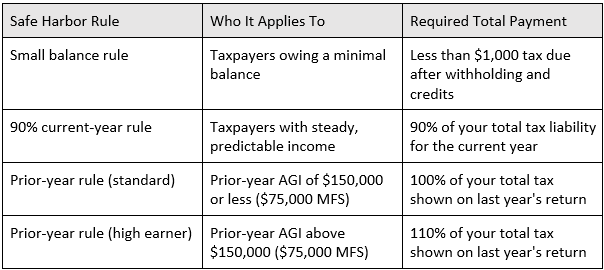
Qualifying for safe harbor doesn't mean you don't owe tax on the income spike. It just prevents the IRS from charging the underpayment penalty on the unpaid balance when you file. You still owe the remaining tax by April 15.
Strategy 1: Lock in the 110% Prior-Year Benchmark
If your income jumps drastically during the year, say from $200,000 to $1,000,000, trying to calculate 90% of your current-year tax liability is a moving target. If your prior-year AGI was above $150,000 (or $75,000 if married filing separately), the tax code requires 110% of last year's tax rather than 100%, and that's actually the easier number to work with.
Here's how to use it:
- Confirm your prior-year AGI was above the $150,000 / $75,000 threshold, which puts you in the 110% tier rather than the standard 100% one.
- Locate your total tax liability on line 24 of last year's Form 1040.
- Multiply that figure by 110%.
- Pay that amount across four equal quarterly installments, or through employer with holding.
Even if the income spike pushes your current-year tax bill to $300,000, paying 110% of last year's tax (say, $44,000) guarantees zero under payment penalties. You can hold the rest of what you'll ultimately owe in a high-yield account until April 15.
Strategy 2: Use Form 2210 Schedule AI for Late-Year Windfalls
The IRS normally calculates underpayment penalties on a quarterly basis, assuming income is earned evenly throughout the year. If you receive a large capital gain or business payout in Q4, the standard calculation backdates your tax obligation to Q1, penalizing you for not making large estimated payments before that income even existed.
Form 2210, Schedule AI (the Annualized Income Installment Method) fixes this:
- Track income by quarter. Break down gross income, AGI, and deductions into four cumulative periods: January through March, January through May, January through August, and January through December.
- Annualize each period. Multiply each period's cumulative income by the IRS's annualization factors, 4.0, 2.4, 1.5,and 1.0, to project a full-year equivalent for each period.
- Calculate tax per period. Compute the required installment for each quarter based on that period's actual annualized earnings, not a flat 25% of the annual total.
- Attach Schedule AI to Form 2210 when filing, to show the IRS that the earlier shortfall was due to income that genuinely hadn't arrived yet.
Strategy 3: The Late-Year Withholding "Time Machine"
Estimated tax payments (Form 1040-ES) are credited on the exact date the IRS receives them. A lump-sum payment in December doesn't retroactively fix an underpaid Q1, Q2, orQ3.
Withholding works differently. The IRS treats tax withheld at the source, whether from a paycheck, a pension, an IRA distribution, or vested stock compensation, as if it were paid evenly across all four quarters, regardless of when it actually happened. This isn't limited to W-2 wages; it applies to any income source where you can request or adjust withholding.
So if you realize late in the year, say in November, that you've underpaid due to an income spike:
- If you have W-2 income, submit an updated Form W-4 to your employer. If the income came from a pension, annuity, or IRA distribution, use Form W-4P or W-4R instead to adjustor request withholding directly from the payer.
- Request that 100% of your remaining paychecks, a year-end bonus, or an upcoming distribution be with held for federal tax.
- Because that withholding counts as paid evenly across Q1 through Q4, it effectively erases the earlier quarters' underpayment penalties retroactively.
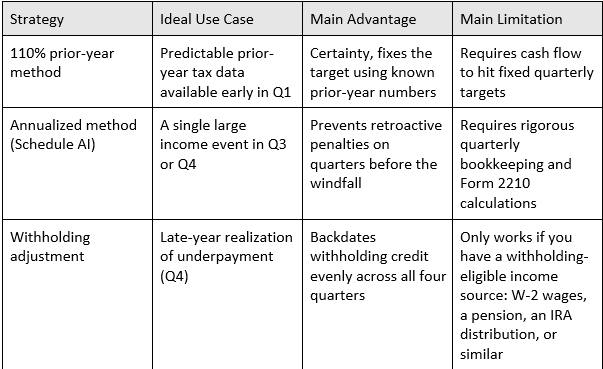
Comparing the Three Strategies
Conclusion
When income fluctuates because of a business exit, equity vesting, or a large capital gain, static quarter-by-quarter tax planning falls apart. Sproutax runs real-time quarterly withholding projections and models custom safe harbor thresholds, helping clients lock in the right prior-year benchmark or adjust withholding at the right moment to stay fully protected from the underpayment penalty. Schedule AI annualization is available for certain income patterns, though for one-time events like a business sale it's often less practical than the prior-year or withholding-based approaches above.
Book a free consultation with Sproutax to model your safe harbor strategy.

About The Author
Alan Nathan, is a CPA and has spent more than 36 years helping individuals and trustees navigate taxation with confidence. He enjoys sharing his insights and experience to make taxes easier to understand. Throughout his career he has guided clients toward smart strategies and real savings. He believes in giving individual taxation the attention to detail it deserves and is passionate about using taxation to create opportunities for long–term financial success.
FAQs
If I qualify for safe harbor, does that mean I owe nothing on April 15?

What is the IRS underpayment penalty rate for 2026?
Can I avoid penalties if my income spike was due to a disaster or emergency?
How do state estimated tax safe harbor rules differ from federal rules?

Get A Call From Our Team Of Expert CPAs

Get Insights
We analyze your previous year return to tell you strategies that can help you plan better.

Seamless Experience
Submit & get a call from our client relations team to connect you with our CPAs.

Pricing That Makes Sense
We tailor pricing based on the complexity of your return so that you pay the right price.

Office Address:
720 Hopmeadow Street2nd Floor
Simsbury, CT 06070
Mail: info@sproutax.com
Phone: (860) 251-9449
Phone: (860) 251-9449
© 2026 Sproutax. All rights reserved.
.svg)
.svg)
