Plan Smarter. Grow Stronger. Don’t miss our latest financial strategies.


August 11, 2026
The Home Office Deduction: A Complete Guide for the Self-Employed
✅ Information Verified By a CPA




The home office deduction is one of the most effective, and most frequently missed, tax write-offs available to self-employed professionals, freelancers, and small business owners filing Form 1040.
For years, business owners avoided taking this deduction out of fear it would flag their return for an audit. In reality, the IRS explicitly permits eligible home-based businesses to write off a portion of their housing costs. Claiming it safely just requires understanding how the IRS defines qualified space, picking the calculation method that maximizes savings, and keeping clean documentation.
Who Qualifies (and Who Doesn't)
Not everyone who works from home can claim home office expenses. Eligibility comes down to your tax filing structure.
Qualifies:
- Sole proprietors and freelancers. Independent contractors and gig workers reporting income on Schedule C.
- Partners in partnerships. Partners who pay unreimbursed home office expenses required under their partnership agreement.
- Single-member LLCs. LLC owners taxed as sole proprietorships.
- S-Corp/C-Corp owners. Business owners who set up a corporate reimbursement program (an Accountable Plan).
Does not qualify:
- W-2 employees. Under the Tax Cuts and Jobs Act, and now made permanent, W-2 remote employees can't claim a federal home office deduction on Form 1040, even if working from home is required by their employer.
- Multi-purpose work spaces. A kitchen table or shared family living room doesn't count, no matter how often it's used for work.
The 3 Non-Negotiable IRS Tests
To claim the deduction, your workspace has to satisfy three criteria:
- Exclusive use. A specific area of your home must be used strictly for business. It doesn't need to be a whole separate room, a dedicated corner of a bedroom with a desk works, as long as no personal activity happens there.
- Regular use. The space needs to be used on an ongoing, recurring basis. Occasional or incidental business tasks in a room don't qualify for it.
- Principal place of business. Your home office needs to be your primary location for administrative, management, or core revenue-generating work, or a place where you regularly meet clients, patients, or customers.
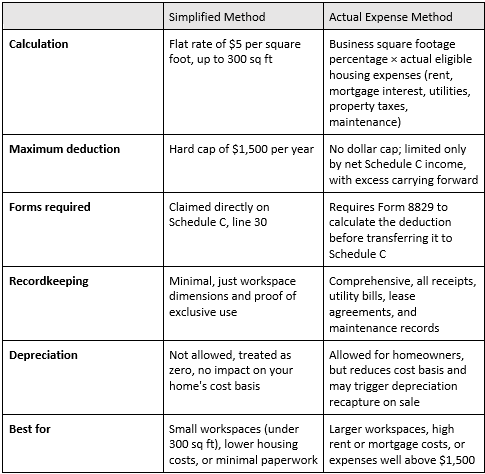
Simplified Method vs. Actual Expense Method
Self-employed taxpayers filing Form 1040 can choose between two calculation methods each year.
Workflow to Audit-Proof Your Write-Off
A structured preparation routine is what makes a deduction hold up to IRS scrutiny.
- Measure your workspace accurately. Measure the length and width of your dedicated office area for total square footage, then measure your home's total livable area to establish your business-use percentage (for example, a 200 sq ft office in a 1,000 sq ft apartment is 20% business use).
- Photograph and document the setup. Take 2 to 3 photos showing your dedicated desk, equipment, and workspace, and keep them stored digitally with your permanent tax files.
- Categorize direct vs. indirect expenses. Direct expenses, repairs or upgrades made only to the office, like painting that room, are 100% deductible. Indirect expenses for the whole home, rent, electricity, gas, water, internet, are deductible based on your business percentage.
- Run both calculation methods. Compare the $5/sq ft simplified calculation against your actual expense receipts, and use whichever produces the larger deduction for the year.
- Report it correctly. Simplified method: enter your square footage and claim it directly on Schedule C, line 30. Actual expense method: detail your housing costs on Form 8829 first, then transfer the allowed total to Schedule C.
S-Corporation Accountable Plans
If your business is structured as an S-Corp, you can't claim home office expenses directly on Schedule C, because S-Corp owners don't file one. Instead, you need an IRS Accountable Plan:
- Submit monthly expense reports. Asan employee-owner, submit a formal monthly reimbursement request to your S-Corp reflecting your actual home office percentage of costs (rent, utilities, internet).
- Get reimbursed tax-free. The S-Corp pays you back directly for those expenses.
- Capture the double tax advantage. For the S-Corp, the reimbursement is fully deductible as a corporate operating expense, reducing net corporate income. For the owner, the cash received is a tax-free reimbursement, it doesn't count as taxable W-2 wages or trigger self-employment tax.
Conclusion
The home office deduction remains one of the cleanest ways to turn everyday living expenses into a legitimate write-off. Maintaining a dedicated workspace, keeping photo evidence, and running both calculation methods before filing is what lets you claim it with confidence.
Sproutax helps self-employed professionals and business owners navigate complex write-offs, model both calculation methods for maximum savings, and set up compliant S-Corp Accountable Plans to keep the return audit-proof. Schedule a home office tax strategy consultation with Sproutax today.

About The Author
Alan Nathan, is a CPA and has spent more than 36 years helping individuals and trustees navigate taxation with confidence. He enjoys sharing his insights and experience to make taxes easier to understand. Throughout his career he has guided clients toward smart strategies and real savings. He believes in giving individual taxation the attention to detail it deserves and is passionate about using taxation to create opportunities for long–term financial success.
FAQs
Can I claim the home office deduction if I rent my apartment or home?

Does claiming a home office deduction automatically trigger an IRS audit?
What is depreciation recapture for homeowners using actual expenses?
Can I deduct 100% of my household internet bill?


Get A Call From Our Team Of Expert CPAs

Get Insights
We analyze your previous year return to tell you strategies that can help you plan better.

Seamless Experience
Submit & get a call from our client relations team to connect you with our CPAs.

Pricing That Makes Sense
We tailor pricing based on the complexity of your return so that you pay the right price.

Office Address:
720 Hopmeadow Street2nd Floor
Simsbury, CT 06070
Mail: info@sproutax.com
Phone: (860) 251-9449
Phone: (860) 251-9449
© 2026 Sproutax. All rights reserved.
.svg)
.svg)
