Plan Smarter. Grow Stronger. Don’t miss our latest financial strategies.


August 18, 2026
The IRS Offer in Compromise: How the Math Actually Works
✅ Information Verified By a CPA





Late-night commercials and online ads often market the IRS Offer in Compromise (OIC) as a magic reset button, promising that almost anyone with back taxes can settle for "pennies on the dollar."
The reality is stricter. The IRS rejects most unsolicited offers because taxpayers don't meet the statutory standards, and the agency isn't running a settlement clearance sale. It's legally obligated to collect the maximum amount possible before the ten-year statutory clock on collections runs out.
An Offer in Compromise does work, but only under specific mathematical and legal conditions. Understanding how the IRS evaluates your financial footprint is the difference between resolving your debt and losing months to processing delays on an offer that was never going to be accepted.
The "Pennies on the Dollar" Myth vs. IRS Reality
An Offer in Compromise is an official agreement that settles a tax debt for less than the full amount owed.
Acceptance rates vary meaningfully from year to year, recent data has ranged from roughly 20% to 40%of submitted offers, depending on the year and how the applications were prepared. The IRS accepts an offer when the proposed amount represents the absolute maximum the agency can reasonably expect to collect before the Collection Statute Expiration Date (CSED).
If the IRS believes it can collect more through a monthly installment agreement, wage garnishment, or asset liquidation, it will reject the offer. An OIC is a mathematical formula, not a flexible negotiation.
The 3 Legal Grounds for an Offer in Compromise
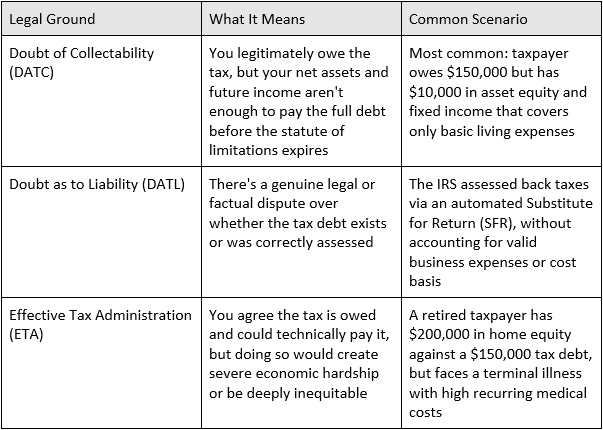
To qualify, your situation needs to fit one of three categories recognized under IRC §7122:
How the IRS Calculates Reasonable Collection Potential (RCP)
For most tax payers applying under Doubt of Collectability, the offer's fate comes down to one calculation: Reasonable Collection Potential (RCP).
RCP= Net Asset Equity + Future Remaining Income
Net asset equity. The IRS calculates the Quick Sale Value (QSV) of your assets, roughly 80% of Fair Market Value, minus any senior encumbrances like mortgages or auto loans. Assets evaluated include:
- Real estate and land equity
- Bank accounts, brokerage accounts, and crypto holdings
- Retirement accounts(401(k)/IRA, factored after early withdrawal penalties and tax impact)
- Vehicles, inventory, and business equipment
Future remaining income. The IRS calculates monthly disposable income by taking gross monthly income and subtracting allowable expenses. It doesn't care what you actually spend on lifestyle costs; your budget gets forced into strict IRS National Standards for housing, utilities, food, clothing, and transportation.
That monthly disposable income is then multiplied by a factor based on your proposed payment method:
- Lump sum cash offer: pay in 5 or fewer installments within 5 months of acceptance. Monthly disposable income is multiplied by 12.
- Periodic payment offer: pay in monthly installments over 6 to 24 months. Monthly disposable income is multiplied by24.
Example: If your net asset equity is $5,000 and your IRS-allowed monthly disposable income is $200 under a lump sum offer:
RCP = $5,000 + ($200× 12) = $7,400
An offer of $7,400 will likely be accepted. An offer of $2,000 will be automatically rejected.
The Non-Negotiable Compliance Prerequisites
Before an IRS officer even looks at your financial disclosure, your application has to clear the compliance gate. The IRS will instantly return your application, and keep your application fee, if you fail any of these:
- Unfiled returns. Every required federal tax return for prior years must be filed.
- Current-year with holding or estimates. You need to be fully caught up on this year's tax obligations, proper W-2withholding or the required quarterly estimated payments.
- Active bankruptcy. You can't have an open bankruptcy proceeding.
- Federal tax deposits (business owners). All required quarterly payroll tax deposits must be current.
The OIC Submission and Review Process
Executing a successful Offer in Compromise takes meticulous documentation.
- Compile financial disclosures (Form 433-A (OIC) / Form 433-B (OIC)). Gather 3 to 6 months of bank statements, pay stubs, mortgage notes, vehicle titles, and recurring bill statements, then complete the Collection Information Statement documenting gross income, assets, and allowable expense caps.
- Draft the formal offer package (Form 656). Detail the tax years involved, the legal grounds for the offer, and the exact settlement amount based on your RCP calculation.
- Submit the package with upfront funds. Pay the non-refundable $205 application fee alongside the required initial offer payment (20% down for a lump sum offer, or the first monthly payment fora periodic offer), unless you qualify for the Low-Income Certification exception.
- Enter the IRS processing window. Once accepted for processing, the IRS places a hold on active levies and garnishments. By law, if the IRS doesn't decide on your offer within 24 months of receipt, it's automatically accepted.
- Negotiate with the IRS examiner. An offer examiner reviews every line item. Be ready to defend disputed expenses, justify asset valuations, or appeal to the IRS Office of Appeals if the offer is initially rejected.
Conclusion
Submitting an unviable Offer in Compromise does more than waste time, it extends the statute of limitations on your tax debt while the IRS reviews the file. An OIC is a powerful resolution tool, but only when it's backed by precise mathematical proof, not hope. Anyone considering one should run the RCP calculation honestly before filing, since a rejected offer costs real time on the collections clock without buying anything in return.
Sproutax models Reasonable Collection Potential(RCP) precisely to determine if an Offer in Compromise is viable before you file, protecting your time and the collections clock. Schedule a consultation with Sproutax today to evaluate your tax resolution options.

About The Author
Alan Nathan, is a CPA and has spent more than 36 years helping individuals and trustees navigate taxation with confidence. He enjoys sharing his insights and experience to make taxes easier to understand. Throughout his career he has guided clients toward smart strategies and real savings. He believes in giving individual taxation the attention to detail it deserves and is passionate about using taxation to create opportunities for long–term financial success.
FAQs
Will the IRS seize my primary home if I apply for an Offer in Compromise?

What happens to my tax refunds while an Offer in Compromise is being processed?
How long does the IRS take to decide on an Offer in Compromise?
What happens if I fail to stay compliant after my Offer in Compromise is accepted?


Get A Call From Our Team Of Expert CPAs

Get Insights
We analyze your previous year return to tell you strategies that can help you plan better.

Seamless Experience
Submit & get a call from our client relations team to connect you with our CPAs.

Pricing That Makes Sense
We tailor pricing based on the complexity of your return so that you pay the right price.

Office Address:
720 Hopmeadow Street2nd Floor
Simsbury, CT 06070
Mail: info@sproutax.com
Phone: (860) 251-9449
Phone: (860) 251-9449
© 2026 Sproutax. All rights reserved.
.svg)
.svg)
